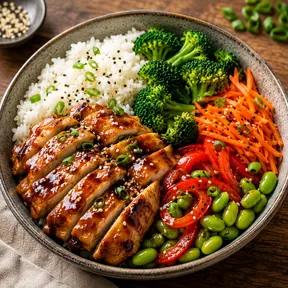
And how many carbs, how much fat? Those are your macros, the three sources of calories on your plate. Answer three questions and we'll tell you how many grams of each to eat per day.
This calculator needs JavaScript to show your result. The calculation runs entirely in your browser.
1You
years
cm
ft
in
kg
lb
The calculation runs in your browser: nothing is sent.
2Your activity
Torn between two? Pick the lower one.
3Your goal
You can change it at any time.
Split
kcal
Only if a health professional gave you a number. Otherwise, leave it blank.
Your result
Example · replace with your own valuesCalculated for you
What you burn comes from the Mifflin-St Jeor formula multiplied by your activity level. Your target applies your goal to that number, then we split it between protein, carbs and fat.
Your goalLoseMaintainBuildManualLoseweightyour weightmuscletarget you enteredtarget from your deficit plan
Enter your age (18 to 80), your height and your weight in step 1: your result appears right away.
Your macros for the day
gProtein of calories
gCarbs of calories
gFat of calories
Your BMI is over 30: your protein is based on the weight that gives a BMI of 25 at your height, which is .
Your protein was taking up a lot of room: fat drops to 20% to stay within your target.
This target is too low for your recommended protein ( g) plus a minimum of fat: protein lowered to g, carbs to 0 g. A higher target would cover them.
We don't go below kcal per day for weight loss: that's the minimum used here.
What you burn is already below the kcal minimum used for weight loss: your target stays at what you burn, with no deficit. Moving a little more is the simplest option.
The manual target needs to be between 1,000 and 6,000 kcal, so it's being ignored.
Per meal
How many times do you eat a day, snacks included?
Protein
g
Carbs
g
Fat
g
Per meal. A simple plate is enough: one source of protein, one of carbs, a little fat.
To picture it
Your target for the day, compared to a single food. A picture, not a menu.
Your g of protein is as much as of roast chicken
Your g of carbs is as much as of cooked white rice
Your g of fat is as much astablespoon of olive oiltablespoons of olive oil
USDA FoodData Central references: roast chicken has 31 g of protein per 100 g, cooked white rice 28 g of carbs per 100 g, olive oil 13.5 g of fat per tablespoon.
The numbers behind it
Tap “?” to understand each number.
What you burn per day
kcal
Your maintenance (TDEE): the calories your body uses in a day, activity included. Eat this much and your weight stays the same.
Burned at rest
kcal
Your basal metabolic rate: the energy to breathe, keep your heart beating and hold your body temperature, without moving. Mifflin-St Jeor formula.
Gap from what you burn
kcal
Weight loss: 550 kcal below what you burn, about 0.5 kg (1.1 lb) a week, without going below kcal per day. Muscle gain: 10% above. Maintenance: no difference.
You entered a manual target: the difference is the gap from what you burn.
This target comes from your deficit plan: the difference is the gap from what you burn.
Your BMI
Body mass index: your weight divided by your height squared. At 30 and above, protein is based on the weight for a BMI of 25.
Your target kcal g g g
Estimates for healthy adults aged 18 to 80, not medical advice. Pregnant, breastfeeding, or being treated for an illness or an eating disorder? Ask a doctor or a dietitian before changing your diet.
Your calories: protein , carbs , fat Calorie breakdown unavailable
The essentials
What each macro does
Protein (4 kcal per gram) maintains your muscles and keeps you full. Carbs (4 kcal per gram) are the main source of energy, especially during exercise. Fat (9 kcal per gram) is essential, in particular for absorbing certain vitamins.
More protein in a deficit
1.8 g per kilo to lose weight, 1.4 g to maintain it, 1.6 g to build muscle: within the range of 1.4 to 2.0 g per kilo that the ISSN gives for active people. At a BMI of 30 or more, the calculation uses the weight for a BMI of 25 at your height.
An example
2,170 kcal per day, 80 kg (176 lb) and 1.80 m (5 ft 11 in), losing weight, balanced split: 144 g of protein, 72 g of fat and 236 g of carbs. Over three meals and a snack, a little more than 35 g of protein each time.
The three splits
Balanced: 30% of calories from fat. High protein: 0.4 g more protein per kilo. Lower carb: 40% fat. If protein and fat go over the target, fat drops as low as 20%, and the result says so. If the target doesn't even leave room for the protein, protein takes what's left after 20% fat, and carbs fall to zero.
Frequently asked questions
How much protein per day?
Between 1.4 and 2.0 g per kilo of body weight (about 0.6 to 0.9 g per pound) for an active person, according to the ISSN. This calculator uses 1.4 g/kg to maintain your weight, 1.6 g/kg to build muscle and 1.8 g/kg to lose weight. For 70 kg (154 lb), that comes to between 98 and 126 g per day.
How many carbs per day?
There's no single number: once your protein and fat are set, carbs make up the rest of your calories. In the example of 2,170 kcal for weight loss, that comes to 236 g per day. To lose weight, total calories matter first, not carbs alone.
How much protein is in an egg?
About 6 g in a large 50 g egg without the shell, according to the USDA. Three eggs therefore provide roughly 18 g, half of a 35 g serving.
Do I need to count my macros to the gram?
No. Labels and estimates already have their own margin of error. Aim for an average over the week rather than an exact number every day.
Which split should I choose?
Start with balanced. Pick high protein if you do strength training, lower carb if you prefer higher-fat meals. At equal calories, the effect on your weight stays similar: choose the one you'll stick with.
Does Hephira track macros?
Yes. You send your meal on WhatsApp, as a photo, a voice note or text. Hephira estimates the calories, protein, carbs and fat, and keeps your journal.
Jäger R, Kerksick CM, Campbell BI, et al. International Society of Sports Nutrition Position Stand: protein and exercise. J Int Soc Sports Nutr. 2017;14:20. doi:10.1186/s12970-017-0177-8
Hall KD, Guo J. Obesity energetics: body weight regulation and the effects of diet composition. Gastroenterology. 2017;152(7):1718-1727. doi:10.1053/j.gastro.2017.01.052
U.S. Department of Agriculture, FoodData Central. fdc.nal.usda.gov
Updated on · Written by the Hephira team
Track your meals without counting everything by hand
Send your meal on WhatsApp, as a photo, a voice note or text. Hephira estimates the calories and macros in a few seconds and keeps your journal. No app to install.